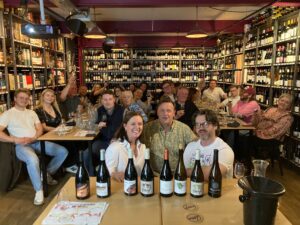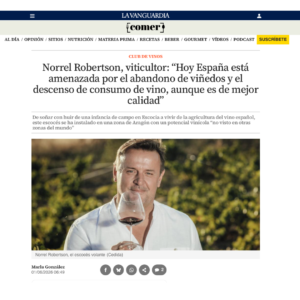

It was an absolute pleasure to do this interview last week with Mariano and his team for the Con Mucho Gusto supplement. English translation below.
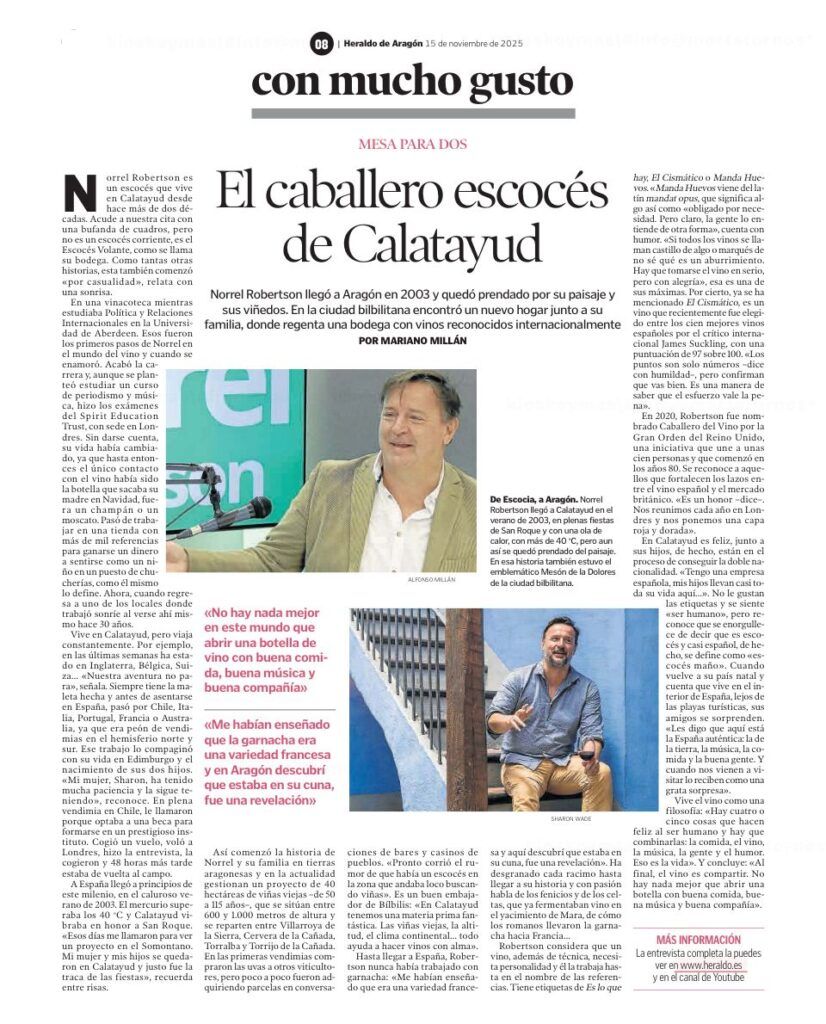
“Norrel Robertson is a Scotsman who has been living in Calatayud for more than two decades. He shows up to our meeting wearing a checkered scarf, but he isn’t an ordinary Scotsman—he is the Flying Scotsman, as his winery is called. Like so many other stories, this one also began “by chance,” he recalls with a smile.
It started in a wine shop while he was studying Politics and International Relations at the University of Aberdeen. Those were Norrel’s first steps into the world of wine, and when he fell in love with it. He finished his degree and, although he considered studying a course in journalism and music, he took the exams of the Spirit Education Trust, based in London. Without realizing it, his life had changed, since until then his only contact with wine had been the bottle his mother would bring out at Christmas—whether it was champagne or moscato. He went from working in a shop with more than a thousand labels just to earn some money, to feeling “like a kid in a candy store,” as he puts it. Now, when he returns to one of the places where he worked, he smiles when he sees himself back there 30 years ago.
He lives in Calatayud, but he travels constantly. For example, in recent weeks he has been in England, Belgium, Switzerland… “Our adventure doesn’t stop,” he says. His suitcase is always packed, and before settling in Spain, he traveled through Chile, Italy, Portugal, France and Australia, since he worked as a harvest worker in both the northern and southern hemispheres. He combined that job with his life in Edinburgh and the birth of his two children.
“My wife, Sharon, has had a lot of patience—and still does,” he admits. In the middle of the harvest in Chile, he received a call telling him he was being considered for a scholarship to train at a prestigious institute. He took a flight, flew to London, did the interview, was accepted, and 48 hours later was back in the fields.
He arrived in Spain at the beginning of this millennium, during the scorching summer of 2003. Temperatures passed 40°C and Calatayud was celebrating San Roque. “Those days they called me to see a project in Somontano. My wife and children stayed in Calatayud, and it happened to be during the fireworks of the festival finale,” he recalls, laughing.
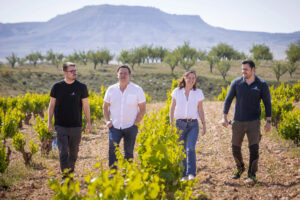
Thus began the story of Norrel and his family in Aragon, and today they manage a project of 40 hectares of old vineyards—between 50 and 115 years old—spread between 600 and 1,000 meters of altitude, located in Villarroya de la Sierra, Cervera de la Cañada, Torralba and Torrijo de la Cañada.
In the first harvests they bought grapes from other growers, but little by little they began acquiring plots through conversations in village bars and casinos. “Soon the rumor spread that there was a Scotsman in the area who was crazy about finding vineyards.” He is a good ambassador of Bilbilis: “In Calatayud we have fantastic raw material. The old vines, the altitude, the continental climate… everything helps to make wines with soul.”
Until he arrived in Spain, Robertson had never worked with garnacha: “I had been taught that it was a French variety, and here I discovered that I was in its birthplace—it was a revelation.” He has studied every cluster down to its history, and speaks passionately about the Phoenicians and Celts, who were already fermenting wine at the archaeological site of Mara, and about how the Romans brought garnacha to France.
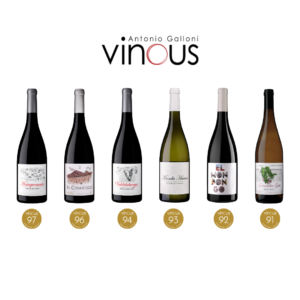
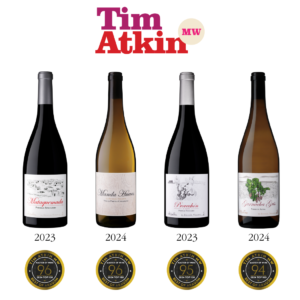
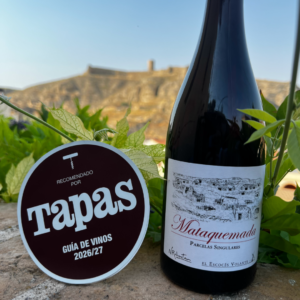
Robertson believes that a wine, besides technique, needs personality—and he works on this right down to the names of the bottles. He has labels such as Es lo que hay (“It is what it is”), El Cismático (“The Schismatic”) or Manda Huevos. “‘Manda Huevos’ comes from the Latin mandat opus, which means something like ‘forced by necessity’. But of course, people understand it differently,” he says with humor. “If all wines are called Castle of Something or Marquis of Something Else, it’s boring. You have to take wine seriously, but with joy”—that is one of his mottos.
By the way, El Cismático was recently chosen among the hundred best Spanish wines by the international critic James Suckling, scoring 97 out of 100. “Points are just numbers,” he says modestly, “but they confirm that you’re doing well. It’s a way of knowing that the effort is worth it.”
In 2020, Robertson was named Caballero del Vino by the Gran Orden del Reino Unido, an initiative that brings together about one hundred people and began in the 1980s. It recognizes those who strengthen ties between Spanish wine and the British market. “It’s an honor,” he says. “We meet every year in London and wear a red and gold cape.”
In Calatayud he is happy, together with his children—in fact, they are in the process of obtaining dual nationality. “I have a Spanish company, my children have spent almost their whole lives here…” He doesn’t like labels and considers himself “a human being,” but he admits that he is proud to say he is Scottish and almost Spanish; in fact, he describes himself as “a maño Scotsman.” When he goes back to his home country and tells people he lives in the interior of Spain, far from the tourist beaches, his friends are surprised. “I tell them that this is the authentic Spain: the Spain of the land, the music, the food and the good people. And when they come to visit us, they find it a pleasant surprise.”
He lives wine as a philosophy: “There are four or five things that make people happy, and you have to combine them: food, wine, music, people and humor. That is life.” And he concludes: “In the end, wine is about sharing. There’s nothing better than opening a bottle with good food, good music and good company.”